Evaluating China's agricultural import diversification

For decades Chinese leaders have been clamoring to "diversify" imports of agricultural products to reduce reliance on the United States. Having experienced the trade war with China 7 years ago, U.S. commodity producers have also declared their eagerness to diversify their export markets. Both diversifications are tough going because Brazil is the only real alternative supplier with capacity to supply China's gargantuan import needs. Likewise, alternative markets are not large enough to absorb the volume of U.S. soybeans sold to China. 

China has been importing enormous quantities of Brazilian soybeans. In calendar year 2024 China boosted its imports of Brazilian soybeans to nearly 75 mmt--over 70% of the total. China imported only 22 million metric tons (mmt) of soybeans from the U.S. last year, but it's hard to see how those beans could be replaced. No other country shows signs of sustained growth as a soybean supplier to China. Imports from Argentina have been up and down. Imports from Uruguay hit 2 mmt in 2024 for the first time. Imports from Russia during 2023 and 2024 jumped to over 1.2 mmt after a Russia-China grain trade deal was signed in 2023, still a long way from replacing U.S. supplies. China is trying to nurture soybean suppliers in Africa, but their supplies are small and inconsistent.
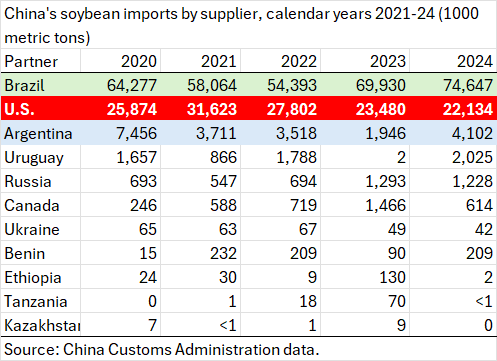

The other side of the equation is the reliance of U.S. soybean producers on sales to China. Indeed, more than half of U.S. soybean exports go to China. The volume of U.S. soybean exports to China stopped growing years ago. U.S. sales dropped dramatically during the first trade war in 2018 when China essentially banned U.S. exports during the peak shipping months. An increase in U.S. soybean sales to alternative markets offset part of the decline that year, but overall exports were down about 9 mmt in 2018. Sales to China rebounded to 34 mmt in 2020 and tailed off to 26-to-30 mmt during 2021-2024. (You may notice that export volumes reported by U.S. data exceed the amount China says it imports from the U.S.)
U.S. export data from USDA Global Agricultural Trade System.

The U.S. sells soybeans to more than 90 countries, but prospects for replacing sales to China are bleak. Sales to Mexico, the EU, other East Asian countries and Egypt have been in decline since 2020 as the U.S. also faces stiff competition from Brazil in some of these markets.


China and the U.S. are less intertwined in corn trade. In 2024 China had 3 chief suppliers of corn imports. China acted in 2012 to dilute its reliance on U.S. as a corn supplier by opening its market to Ukrainian corn and beginning negotiations with Brazil. Ukraine was the top supplier of China's imported corn in 2020. China's imports from Ukraine dropped off slightly in 2022-24 following Russia's invasion of Ukraine. Meanwhile, imports from the U.S. surged in 2021 and 2022. Then, details of a China-Brazil corn import protocol were finally worked out and Brazil suddenly became China's top corn supplier in 2023 and 2024. Imports from other countries like Myanmar, Bulgaria, and Laos have been relatively small and inconsistent from year to year. Despite the 2023 grain trade deal with Russia, China's imports of Russian corn are underwhelming. Starting in mid-2024 China dialed back corn imports from all sources to insulate its farmers from declining corn prices. Corn imports remained unusually low during the first months of 2025.


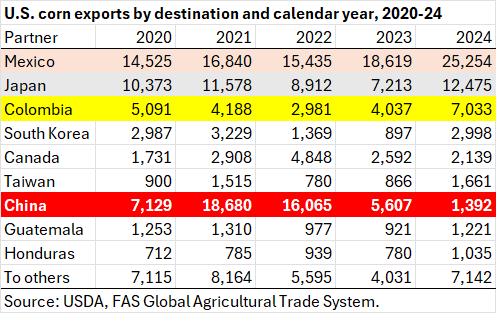
The United States never relied much on China as a corn export market until a surge in sales made China the top foreign market for U.S. corn during 2021-22. That surge was an anomaly attributed to a perfect storm of factors: China's Phase One commitment to buy U.S. products, a 40-percent increase in Chinese corn prices during 2020-21, China's rebuilding of corn stocks following a disgorgement of excess reserves completed in 2019, and a massive rebuilding of its swine herd after a 2018-19 African swine fever epidemic. In historical context the drop in U.S. corn sales to China during 2022-2024 looks like a return to business as usual. U.S. exports of corn to Mexico, Japan, and Colombia boomed in 2024 as sales to China declined.
U.S. export data from USDA Global Agricultural Trade System.


These are just two of the many commodities traded between the U.S. and China. Despite China's bluster about diversifying its import sources, Brazil is the only other country with the resources and productivity to meet China's enormous needs for farm commodities. Brazil is also a top supplier of China's beef, poultry, sugar, and cotton. China's "diversification" actually entails creation of a huge dependence on Brazil.

The U.S. is likewise intent on diversifying its agricultural export markets, but that is also tough going. China has been the main growth pole in global ag commodity demand over the past two decades. While the U.S. has dozens of other overseas markets, there is no single market that can rival China in soybean sales. In corn sales, China has never been a reliable customer and may never be. 

Comments

Popular posts from this blog

Xi Jinping's Doctoral Thesis

Xi Jinping is the vice president and presumed next president of China but little is known about him. In this post the dimsums blog offers its contribution to the genre of Xi Jinping-ology by conveying Xi's decade-old views on agricultural markets. Ten years ago Xi Jinping wrote a thesis, "Tentative Study of Agricultural Marketization" (中国农村市场化研究) for a Doctor of Law degree at Tsinghua University in Beijing, a top breeding-ground for Chinese officials. The dimsums blogger has spent several hours poring over the 200-plus page tome to see what it reveals about Dr. Xi. The thesis is remarkably close to what China has been doing lately in agricultural policy, suggesting that Xi (or the person who actually wrote the thesis) has a major say in policy or is at least in agreement with what's being done. There is nothing adventurous, controversial (or insightful) in the thesis. It seems to be the work of a wonkish technocrat who is not prone to talk out of turn or wander from...

Divergence in U.S. & Chinese egg prices

High egg prices are a hot topic in the United States. China, in contrast, has a glut of eggs and depressed prices.  The March 14, 2025 USDA Agricultural Marketing Service weekly eggs market overview reported that U.S. egg prices continued declining during the second week of March as the supply situation improved. No significant highly pathogenic avian influenza (HPAI) outbreaks have occurred in March and U.S. egg demand is relatively light. The average U.S. wholesale price for Grade A large white eggs was $4.15 per dozen, down sharply from their February peak.  Until 2021, Chinese and U.S. wholesale egg prices had been roughly equal at about $1-to-$2 per dozen with no trend. U.S. prices fluctuated more than Chinese prices, so the U.S. price was sometimes higher, sometimes lower than the Chinese price after converting them to dollars per dozen.  Chinese prices converted using monthly exchange rate and assuming 0.6 kg per dozen. Sources: USDA and China Ministry of Agricult...

China's Corn & Wheat Imports Down 97% From Last Year

China's first customs data for 2025 feature a 97-percent decline in corn and wheat imports from a year earlier. Soybean imports were up slightly by volume (but down in value), and dairy, pork, poultry, and seafood imports rebounded year-on-year. Life was less sweet in China with a 93.7% decline in sugar imports, and drinking appears to be up as wine and beer imports posted gains.   China's agricultural imports for January-February 2025 were down 14.7 percent from a year earlier. The value of farm and food goods imported for the first two months of 2025 totaled $30.7 billion, down $5.26 billion from the same period in 2024. China's exports of agricultural products during January-February totaled $15.2 billion, up $393 million from a year earlier.  Data from China Customs Administration website. As usual, soybeans were the largest component of China's agricultural imports during January-February 2025 with a value of $6.3 billion. Meat imports were valued at $4.1 billion, ...