
China's Corn & Wheat Imports Down 97% From Last Year

China's first customs data for 2025 feature a 97-percent decline in corn and wheat imports from a year earlier. Soybean imports were up slightly by volume (but down in value), and dairy, pork, poultry, and seafood imports rebounded year-on-year. Life was less sweet in China with a 93.7% decline in sugar imports, and drinking appears to be up as wine and beer imports posted gains.  

China's agricultural imports for January-February 2025 were down 14.7 percent from a year earlier. The value of farm and food goods imported for the first two months of 2025 totaled $30.7 billion, down $5.26 billion from the same period in 2024. China's exports of agricultural products during January-February totaled $15.2 billion, up $393 million from a year earlier. 

Data from China Customs Administration website.

As usual, soybeans were the largest component of China's agricultural imports during January-February 2025 with a value of $6.3 billion. Meat imports were valued at $4.1 billion, fruit and nuts $3.8 billion, seafood $3.3 billion, and dairy products $2.1 billion. Cereal grain imports were valued at just $1 billion during January-February. 
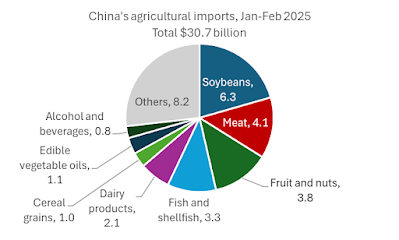
Data from China Customs Administration website.

Grains and soybeans accounted for most of the decline in the value of agricultural imports. January-February cereal grain imports were down $3 billion (-75%) from a year earlier. Soybean imports were down $1.14 billion (-15.3%, due to declining prices), and sugar imports were down $681 million (-93.7%). 

The value of dairy imports was up 19% year-on-year, value of imports of pork and pork offal was up 10.9%, poultry imports were up 15.5%, and seafood imports were up 5.2%. Wine imports were up 54% and beer imports were up 14.2% in the first two months of 2025. 

The quantity of cereal grain imports during January-February 2025 was down by 9.9 million metric tons, a 74.3% decrease from a year earlier. Corn and wheat imports combined totaled just 290,000 metric tons, down 97% from a year earlier. 

Corn imports were down 6 million metric tons (-97.1%) and wheat imports were down 2.39 mmt (-95.6%). Barley imports were down 1 mmt (-37.6%), and sorghum imports were down 600,000 metric tons (-37.5%) year-on-year. Soybean imports of 13.92 mmt during January-February 2025, were up 4.4% from a year earlier. 


The data for these two months was posted on the website of China's Administration of Customs on March 18. Year-on-year analysis is displayed for the two months combined to avoid distortions due to timing of the lunar new year.

Comments

ahmadfabrics said…
Timeless, elegant, and deeply rooted in tradition, Pakistani men’s shalwar kameez Pakistani men’s shalwar kameez is more than just attire—it’s a symbol of cultural pride and refined simplicity. At Ahmad Fabrics International, we bring this iconic ensemble to life with premium fabrics, expert tailoring, and a touch of contemporary sophistication.
deepak said…
Today I came across Radhe Exchange Login while searching online. The page layout looks neat and easy to follow. I didn’t have trouble finding the login section, which is always a good sign. Many websites make the login process complicated, but this one appears straightforward. The page feels well structured and comfortable to browse. Overall, it seems like a thoughtfully designed login page.

Popular posts from this blog

Xi Jinping's Doctoral Thesis

Xi Jinping is the vice president and presumed next president of China but little is known about him. In this post the dimsums blog offers its contribution to the genre of Xi Jinping-ology by conveying Xi's decade-old views on agricultural markets. Ten years ago Xi Jinping wrote a thesis, "Tentative Study of Agricultural Marketization" (中国农村市场化研究) for a Doctor of Law degree at Tsinghua University in Beijing, a top breeding-ground for Chinese officials. The dimsums blogger has spent several hours poring over the 200-plus page tome to see what it reveals about Dr. Xi. The thesis is remarkably close to what China has been doing lately in agricultural policy, suggesting that Xi (or the person who actually wrote the thesis) has a major say in policy or is at least in agreement with what's being done. There is nothing adventurous, controversial (or insightful) in the thesis. It seems to be the work of a wonkish technocrat who is not prone to talk out of turn or wander from...

Divergence in U.S. & Chinese egg prices

High egg prices are a hot topic in the United States. China, in contrast, has a glut of eggs and depressed prices.  The March 14, 2025 USDA Agricultural Marketing Service weekly eggs market overview reported that U.S. egg prices continued declining during the second week of March as the supply situation improved. No significant highly pathogenic avian influenza (HPAI) outbreaks have occurred in March and U.S. egg demand is relatively light. The average U.S. wholesale price for Grade A large white eggs was $4.15 per dozen, down sharply from their February peak.  Until 2021, Chinese and U.S. wholesale egg prices had been roughly equal at about $1-to-$2 per dozen with no trend. U.S. prices fluctuated more than Chinese prices, so the U.S. price was sometimes higher, sometimes lower than the Chinese price after converting them to dollars per dozen.  Chinese prices converted using monthly exchange rate and assuming 0.6 kg per dozen. Sources: USDA and China Ministry of Agricult...