
Hog Companies Increased Dominance in 2022

China's publicly listed hog companies continued boosting their share of sales during 2022. Data compiled by Futures Daily showed that 16 companies reported a combined 129.2-million head sales total in 2022. [update: This is 18.5 percent of national hog slaughter of 700 million head announced today by the National Bureau of Statistics.]
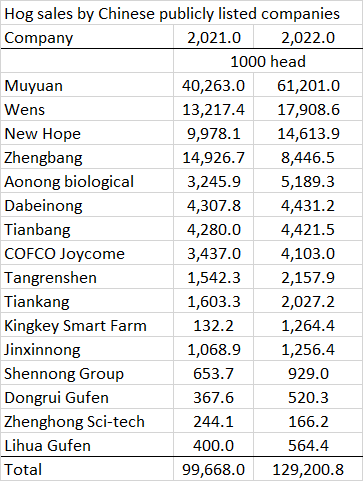
Compiled by Futures Daily from financial reports.

Combined sales by listed companies were up about 30 percent from 2021. The largest company, Muyuan, has tripled its output since 2020. Muyuan sold 61.2 million head last year, up from 40.3 million in 2021 and 18.1 million in 2020. Wens Foodstuff recovered its number-2 position with 17.9 million head after seeing a dramatic drop during the African swine fever years of 2019-20. Financially troubled Zhengbang Sci-tech saw a decline in sales while New Hope Group had another year of expansion. [update: National hog slaughter increased 4.3 percent during 2022, according to the National Bureau of Statistics.]
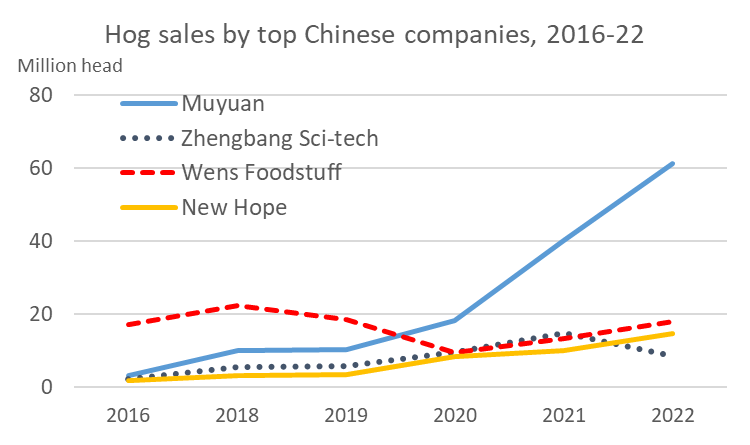
Compiled from financial reports.

China's hog prices, meanwhile, had another roller coaster year. Average Chinese hog prices fell to about 15 yuan per kg--roughly $1/lb--in early January 2023, about where prices started the year. The current price is below production costs announced by listed companies that ranged from 15.5 yuan per kg for Muyuan to 18.4 yuan for several other companies. Hog prices reported by the National Bureau of Statistics were below production costs during the first half of 2022, soared to highly profitable levels during July-October. Prices then plunged to loss-making territory as the year closed out. Many listed companies reported 20-percent declines in price during December 2022, and average prices dipped another 5 percent in the first week of January. 
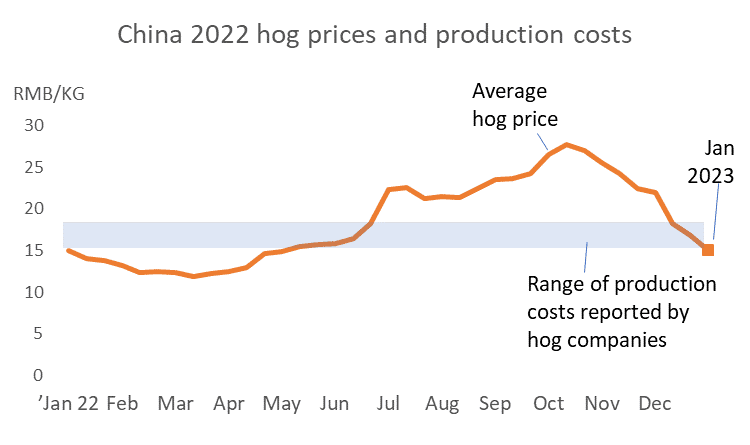
Market reports say large volumes of hogs have come on the market, including many that were held back for "second-time fattening." Consumption during the traditional holiday peak season has been disappointing with virus transmission peaking in cities during December and with a slow Chinese economy. Some farmers are still holding back hogs from the market that could be slaughtered after the Lunar New Year, maintaining a degree of downward pressure into February. 

China's National Development and Reform Commission is alarmed by plunging hog prices. The Commission promises to buy up pork for reserves, is calling in hog company executives to discuss the situation and promises to scrutinize markets for price manipulation.

Comments

Popular posts from this blog

Xi Jinping's Doctoral Thesis

Xi Jinping is the vice president and presumed next president of China but little is known about him. In this post the dimsums blog offers its contribution to the genre of Xi Jinping-ology by conveying Xi's decade-old views on agricultural markets. Ten years ago Xi Jinping wrote a thesis, "Tentative Study of Agricultural Marketization" (中国农村市场化研究) for a Doctor of Law degree at Tsinghua University in Beijing, a top breeding-ground for Chinese officials. The dimsums blogger has spent several hours poring over the 200-plus page tome to see what it reveals about Dr. Xi. The thesis is remarkably close to what China has been doing lately in agricultural policy, suggesting that Xi (or the person who actually wrote the thesis) has a major say in policy or is at least in agreement with what's being done. There is nothing adventurous, controversial (or insightful) in the thesis. It seems to be the work of a wonkish technocrat who is not prone to talk out of turn or wander from...

Divergence in U.S. & Chinese egg prices

High egg prices are a hot topic in the United States. China, in contrast, has a glut of eggs and depressed prices.  The March 14, 2025 USDA Agricultural Marketing Service weekly eggs market overview reported that U.S. egg prices continued declining during the second week of March as the supply situation improved. No significant highly pathogenic avian influenza (HPAI) outbreaks have occurred in March and U.S. egg demand is relatively light. The average U.S. wholesale price for Grade A large white eggs was $4.15 per dozen, down sharply from their February peak.  Until 2021, Chinese and U.S. wholesale egg prices had been roughly equal at about $1-to-$2 per dozen with no trend. U.S. prices fluctuated more than Chinese prices, so the U.S. price was sometimes higher, sometimes lower than the Chinese price after converting them to dollars per dozen.  Chinese prices converted using monthly exchange rate and assuming 0.6 kg per dozen. Sources: USDA and China Ministry of Agricult...

China's Corn & Wheat Imports Down 97% From Last Year

China's first customs data for 2025 feature a 97-percent decline in corn and wheat imports from a year earlier. Soybean imports were up slightly by volume (but down in value), and dairy, pork, poultry, and seafood imports rebounded year-on-year. Life was less sweet in China with a 93.7% decline in sugar imports, and drinking appears to be up as wine and beer imports posted gains.   China's agricultural imports for January-February 2025 were down 14.7 percent from a year earlier. The value of farm and food goods imported for the first two months of 2025 totaled $30.7 billion, down $5.26 billion from the same period in 2024. China's exports of agricultural products during January-February totaled $15.2 billion, up $393 million from a year earlier.  Data from China Customs Administration website. As usual, soybeans were the largest component of China's agricultural imports during January-February 2025 with a value of $6.3 billion. Meat imports were valued at $4.1 billion, ...