China is on alert for the impending spread of the COVID-19 virus in the countryside. A December 24 videoconference on rural COVID-19 prevention and control ordered officials to be on the alert to fight the spread of the virus in rural areas expected as millions of people return to their home towns during the January holidays.
Today's Securities Times reported that the virus was spreading rapidly in late December. An online survey conducted by provincial disease control authorities showed that 35% of Hainan Province's population was infected during the week of December 19-25, up from 5.6% the previous week. Hainan authorities expect the infection rate to reach 50%. Various cities in Zhejiang Province had infection rates of 30%-to-40%, and Sichuan Province estimated its infection rate at 64.5% during the last week of December 2022.
Officials at the December 24 meeting were warned that the countryside is a weak spot for virus control due to the vast population with low vaccination rates. With city hospitals already apparently overwhelmed with COVID cases, officials are concerned that the rickety system of village clinics and crude county hospitals will be unable to cope with a flood of sick people. Authorities in agricultural and rural offices at each level were ordered to
- distribute medical supplies, improve medical services and critical care
- focus virus prevention work on key rural regions and populations
- concentrate on vaccination and health services for the elderly population
- ensure that winter vegetable and livestock production is unimpeded
- set detailed emergency programs to supply farm inputs for spring cultivation and seeding
The elderly have the highest risk of severe illness and mortality from COVID-19--a tendency that seems to be confirmed by recent videos of hospital wards in China crowded with elderly people. According to China's 2020 population census, China has 264 million people aged 60 and older, of which 121 million reside in rural villages and 53 million in towns. People 60 and older comprised 24% of the countryside's population and about 16% of people in towns and cities.
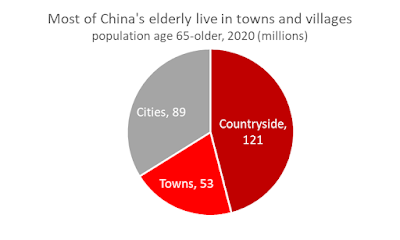 |
| Source: China's 2020 population census. |
The spread of COVID-19 among the rural elderly could also affect the agricultural workforce. China's last agricultural census in 2016 showed that 105 million agricultural operators were aged 55 and older, about one-third of the total.

Source: China's third agricultural census, 2016
On December 29, state news media warned that the virus was expected to surge in rural areas during the January 1 and Lunar New Year holidays. All regions are expected to gradually face pressure from the epidemic and medical treatment as people move around the country during the holidays. Officials were admonished to be "more precise," "more scientific in prevention," to treat severe cases and ensure daily medical and health services in order to prevent medical resources from becoming exhausted.
National Health Commissioner Jiao Yahui prioritized distribution of medications to county and township hospitals and village clinics and transferring severely ill rural patients to higher-level hospitals with better treatment capabilities.
Officials have been instructed to identify high-risk groups, including the elderly with co-morbidities, and to establish links between city and county hospitals, dispatch teams of medical professionals to bolster diagnosis and treatment in rural areas, and refer severely ill patients to higher-level hospitals.
A December 29 document issued by the State Council's rural leading group provided more details on the rural virus control strategies. Agricultural measures focus on hitting targets for winter vegetable production, ensuring no interruption of feed and forage supplies for livestock, vigilance against animal disease, tending of over-wintering wheat and rapeseed crops, and ensuring supplies of fertilizer and pesticide.
A collection of documents and stories about rural virus control strategies in various provinces is posted on the Ministry of Agriculture and Rural Affairs web site.
Propaganda shows photos of medical teams standing around rural clinics for photo-ops and cartoons showing doctors rushing off to the countryside. It is unclear how this plan will be accomplished with urban hospitals already overwhelmed and pharmacy shelves picked clean of medications all over the country.
.jpg) |
| Propaganda showing city medical staff rushing to help the countryside with COVID-19 |
Minister of Agriculture and Rural Affairs Tang Renjian was apparently absent from the December 24 meeting on this "urgent" rural matter. The chairmanship of the meeting was entrusted to the director of the Central Revitalization Bureau on behalf of Minister Tang, according to the Ministry's news release. Minister Tang may have been preoccupied with preparations to chair a December 27 meeting to study Xi Jinping's important directives on agriculture and rural development.
Comments