
Same Pork Output, Price Doubles

China's third-quarter pork output in 2022 was about the same as a year ago, yet prices are about twice as high. Something's wrong with this picture.

Data in the National Bureau of Statistics' Q3 2022 report indicate pork output was 12.1 million metric tons, almost the same as last year's Q3 output of 12 million metric tons. The number of hogs slaughtered during Q3 this year was almost identical to last year, at 154.5 million, and the inventory of hogs was slightly higher than a year ago. 

Data from National Bureau of Statistics quarterly reports.

The report claimed that the hog price was up 36 percent from a year ago. The September consumer price index also reported a 36-percent increase in consumer pork prices. However, these figures vastly understate the increase in prices indicated by Ministry of Agriculture price reports which show wholesale pork prices nearly twice as high as last October and hog prices are up nearly 140 percent from last October. 
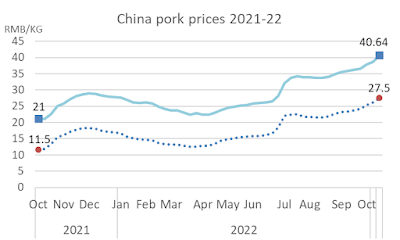
Ministry of Agriculture and Rural Affairs weekly livestock and feed reports.

The National Bureau of Statistics raw material price report for mid-October showed an even larger increase in prices, reporting an average hog price of 26.5 yuan per kg, up 150 percent from 10.5 yuan a year ago. 

National Bureau of Statistics Raw Material Purchase prices.

Consumer demand is not driving up pork prices. Per-capita household expenditures so far in 2022 were up a paltry 1.5 percent from a year earlier, and urban expenditures were down -0.2 percent.

Comments

David Cowhig said…
Refilling the pork strategic stockpile?

https://www.nytimes.com/2019/10/07/business/china-strategic-pork-reserve.html

NYT October 2019

”China Turns to Strategic Pork Reserve
The tariff fight has added to Chinese shoppers’ grocery bills. How is the government coping? By tapping its gigantic stockpile of emergency meat.

“Oct. 7, 2019

BEIJING — When supplies of China’s favorite meat run low, Beijing calls upon its strategic pork reserve, a name that brings to mind vast piles of sausages, bacon and spareribs housed in secret underground vaults across the country.

That’s not quite how it works. But China’s pork reserve is real, and it is basically a carnivore’s version of the Strategic Petroleum Reserve, which keeps the United States flush with oil during emergencies. Pork prices in China today are skyrocketing, the result of an epidemic that is ravaging the country’s hogs, and the government has been drawing upon its reserves to lift supplies for shoppers.

The trade war with the United States hasn’t helped — China’s retaliatory tariffs have made imports of American food and agriculture products more expensive. As the two countries’ negotiators meet this week in Washington for another round of trade talks, ballooning grocery bills are adding to the pressure on Beijing to reach a deal.

Last month, 30,000 metric tons of pork from the national reserve was sold into the market ahead of Oct. 1, the 70th anniversary of modern China’s founding. A batch of 9,600 tons was released in January, shortly before Chinese New Year. Local governments have also tapped their stores.

Popular posts from this blog

Xi Jinping's Doctoral Thesis

Xi Jinping is the vice president and presumed next president of China but little is known about him. In this post the dimsums blog offers its contribution to the genre of Xi Jinping-ology by conveying Xi's decade-old views on agricultural markets. Ten years ago Xi Jinping wrote a thesis, "Tentative Study of Agricultural Marketization" (中国农村市场化研究) for a Doctor of Law degree at Tsinghua University in Beijing, a top breeding-ground for Chinese officials. The dimsums blogger has spent several hours poring over the 200-plus page tome to see what it reveals about Dr. Xi. The thesis is remarkably close to what China has been doing lately in agricultural policy, suggesting that Xi (or the person who actually wrote the thesis) has a major say in policy or is at least in agreement with what's being done. There is nothing adventurous, controversial (or insightful) in the thesis. It seems to be the work of a wonkish technocrat who is not prone to talk out of turn or wander from...

Divergence in U.S. & Chinese egg prices

High egg prices are a hot topic in the United States. China, in contrast, has a glut of eggs and depressed prices.  The March 14, 2025 USDA Agricultural Marketing Service weekly eggs market overview reported that U.S. egg prices continued declining during the second week of March as the supply situation improved. No significant highly pathogenic avian influenza (HPAI) outbreaks have occurred in March and U.S. egg demand is relatively light. The average U.S. wholesale price for Grade A large white eggs was $4.15 per dozen, down sharply from their February peak.  Until 2021, Chinese and U.S. wholesale egg prices had been roughly equal at about $1-to-$2 per dozen with no trend. U.S. prices fluctuated more than Chinese prices, so the U.S. price was sometimes higher, sometimes lower than the Chinese price after converting them to dollars per dozen.  Chinese prices converted using monthly exchange rate and assuming 0.6 kg per dozen. Sources: USDA and China Ministry of Agricult...

China's Corn & Wheat Imports Down 97% From Last Year

China's first customs data for 2025 feature a 97-percent decline in corn and wheat imports from a year earlier. Soybean imports were up slightly by volume (but down in value), and dairy, pork, poultry, and seafood imports rebounded year-on-year. Life was less sweet in China with a 93.7% decline in sugar imports, and drinking appears to be up as wine and beer imports posted gains.   China's agricultural imports for January-February 2025 were down 14.7 percent from a year earlier. The value of farm and food goods imported for the first two months of 2025 totaled $30.7 billion, down $5.26 billion from the same period in 2024. China's exports of agricultural products during January-February totaled $15.2 billion, up $393 million from a year earlier.  Data from China Customs Administration website. As usual, soybeans were the largest component of China's agricultural imports during January-February 2025 with a value of $6.3 billion. Meat imports were valued at $4.1 billion, ...