
Gyrating Pork Prices Vex Chinese Officials

China's August 2022 CPI report said pork prices were up 22 percent from a year earlier, the largest increase of any component of the price index. The Statistics Bureau reckoned that the 10-percent increase for the broader meat category contributed 0.32 percentage points to the 2.5 percent year-on-year rise in consumer prices.

A year ago, the August 2021 CPI report said pork prices were down 44.9 percent from a year earlier, the largest decline of any component of consumer prices. In August last year, the meat component of the CPI pulled down the 0.9-percent CPI change by 1.2 percentage points. 

According to agriculture ministry wholesale market price monitoring, August 2022 pork prices averaged 33.88 yuan per kg (about $2.23 per lb). That was higher than any historical pork price excluding the once-in-a-lifetime prices during Sept 2019 to January 2021 when African swine fever cratered pork supplies. 
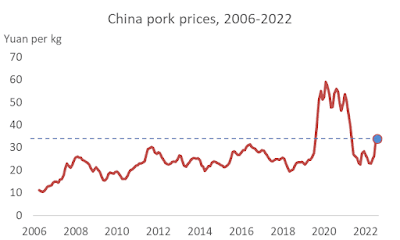
Data from China Ministry of Agriculture and Rural Affairs market monitoring.

Chinese officials have been spooked by the gyrations in pork prices. In a July macroeconomic analysis by the State Council's Development Research Center think tank, three economists investigated the lurking risk of a new rapid surge in pork prices. They zoomed in on the possibility that "excessive shedding of production capacity" due to rising feed costs, a broken financing chain for some large-scale hog producers (e.g. Zhengbang), and over-zealous environmental regulators shutting down pig farms.

The economists said another price spike was unlikely because big farms that can withstand cyclical pressures are squeezing out small independent farms. They were pleased to report that 

  • scaled-up farms producing 500 head or more had increased their share from 53% to 60% between 2019 and 2021. 
  • Sows held by scaled farms increased by 4.4% between April 2021 and June 2022 while sows held by small independent farmers had fallen 11.6%. 
  • High-productivity second-generation sows increased from 50% of the herd in May 2021 to 88 percent in February 2022 as low-productivity third-generation sows have been displaced.
Somewhat more alarming was the financial data for pork companies:
  • While 21 publicly listed hog companies produced 15% of hogs last year, 14 of them reported losses totaling 53.97 billion yuan
  • 20 companies posted losses in the first quarter of 2022 totaling 18.94 billion yuan
  • 14 companies have debt-asset ratios over 60%, and four have ratios over 80%.
  • The report singled out Zhengbang Sci-Tech, the no. 2 pig producer, for its particularly dire financial straits.
The DRC economists judged that the likelihood of a rise in pork prices is low since pork consumption is under pressure due to closure of food service during pandemic lockdowns and a general decline as consumption diversifies away from pork. They said per capita pork consumption fell from 42.6 kg to 40.1 kg between 2014 and 2021. 

After rolling out a dozen policies to accelerate recovery of pig production exactly 3 years ago, the economists now recommend another round of loans and other support policies to prevent excessive exit from the industry. They called for increasing the corn import quota and simplifying procedures to reduce feed prices. They also called for expanding imports of other feed grains like barley and sorghum, distillers dried grains, and oilseed meals while pursuing low-soybean meal feed rations.

What the DRC economists did not bother to ask is why pork prices have surged to an historical high when demand is decidedly lackluster. Doesn't it suggest a supply shortfall? 

The National Development and Reform Commission held meetings in the summer with big hog-producing and pork companies, industry associations and other government departments to warn against hoarding and price manipulation. Authorities learned that the current supply of fattened hogs is sparse due to a reduction of capacity when companies were losing money last year. Companies said they would have to slaughter immature pigs in order to ramp up supplies immediately. 

The NDRC's September meeting once again had an upbeat assessment, concluding that pork supplies are ample and prices will be stable. 

The DRC economists called for cracking down on false information, hoarding and speculation. They meant this for companies, but the government should also stop putting out fake statistics, rosy outlooks, and stop hoarding grain.

Comments

Popular posts from this blog

Xi Jinping's Doctoral Thesis

Xi Jinping is the vice president and presumed next president of China but little is known about him. In this post the dimsums blog offers its contribution to the genre of Xi Jinping-ology by conveying Xi's decade-old views on agricultural markets. Ten years ago Xi Jinping wrote a thesis, "Tentative Study of Agricultural Marketization" (中国农村市场化研究) for a Doctor of Law degree at Tsinghua University in Beijing, a top breeding-ground for Chinese officials. The dimsums blogger has spent several hours poring over the 200-plus page tome to see what it reveals about Dr. Xi. The thesis is remarkably close to what China has been doing lately in agricultural policy, suggesting that Xi (or the person who actually wrote the thesis) has a major say in policy or is at least in agreement with what's being done. There is nothing adventurous, controversial (or insightful) in the thesis. It seems to be the work of a wonkish technocrat who is not prone to talk out of turn or wander from...

Divergence in U.S. & Chinese egg prices

High egg prices are a hot topic in the United States. China, in contrast, has a glut of eggs and depressed prices.  The March 14, 2025 USDA Agricultural Marketing Service weekly eggs market overview reported that U.S. egg prices continued declining during the second week of March as the supply situation improved. No significant highly pathogenic avian influenza (HPAI) outbreaks have occurred in March and U.S. egg demand is relatively light. The average U.S. wholesale price for Grade A large white eggs was $4.15 per dozen, down sharply from their February peak.  Until 2021, Chinese and U.S. wholesale egg prices had been roughly equal at about $1-to-$2 per dozen with no trend. U.S. prices fluctuated more than Chinese prices, so the U.S. price was sometimes higher, sometimes lower than the Chinese price after converting them to dollars per dozen.  Chinese prices converted using monthly exchange rate and assuming 0.6 kg per dozen. Sources: USDA and China Ministry of Agricult...

China's Corn & Wheat Imports Down 97% From Last Year

China's first customs data for 2025 feature a 97-percent decline in corn and wheat imports from a year earlier. Soybean imports were up slightly by volume (but down in value), and dairy, pork, poultry, and seafood imports rebounded year-on-year. Life was less sweet in China with a 93.7% decline in sugar imports, and drinking appears to be up as wine and beer imports posted gains.   China's agricultural imports for January-February 2025 were down 14.7 percent from a year earlier. The value of farm and food goods imported for the first two months of 2025 totaled $30.7 billion, down $5.26 billion from the same period in 2024. China's exports of agricultural products during January-February totaled $15.2 billion, up $393 million from a year earlier.  Data from China Customs Administration website. As usual, soybeans were the largest component of China's agricultural imports during January-February 2025 with a value of $6.3 billion. Meat imports were valued at $4.1 billion, ...