China has tasked a new network of field bosses (田长) with watching for misuse of farmland as new statistics revealed huge losses of cropland in many provinces. The new system selects key people in village groups--the most basic rural unit--to watch over "permanent farmland" to ensure it is not converted to nonfarming uses or planted with non-grain crops. These grassroots field watchers report up to a field boss at the administrative village, who reports to a township field boss, who reports to a prefecture field boss official.
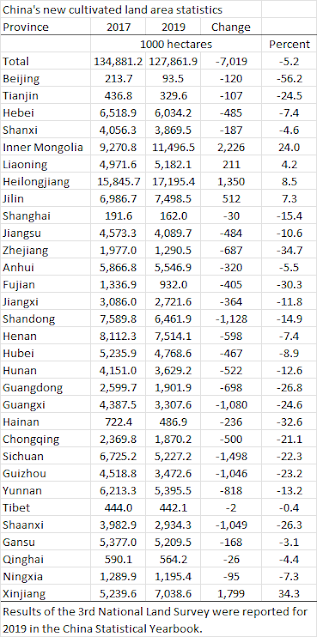
The new farmland-watching system was launched in 2021 after a new national land survey discovered that China's cultivated land base was 5 percent less than had previously been reported in statistics (see table below). Many southern provinces had their cultivated land area cut by 20-to-30 percent after the survey. Major agricultural provinces like Shandong (-15%), Henan and Hebei (-7% each) had reductions. Top rice-producing provinces Hunan and Jiangxi had their cultivated land area cut about 12%. Cultivated area figures were raised for northeastern provinces and Xinjiang Autonomous Region where there have been longstanding disputes over land area, grassland and wetlands have been converted to crops, and other land has been reclaimed for cultivation by state farms.
According to Hunan Daily, the mayor of Xiaochaqiao Town in Hunan Province's Shaodong City explained that Zhenqingjiang Village demolished houses to recover 22 mu (about 2.5 acres) land now being planted in soybeans, pumpkins, and corn. The town's newly-established field boss system has a plan to recover 660 mu (109 acres) using "multiple measures" to "implement the strictest cultivated land protection system."
The hierarchical system is designed to map out all the land designated as "permanent farmland" and assign each "responsibility field" to a field boss to ensure full coverage. When an official discovers that farmland has been illegally occupied or converted to an unauthorized use, the field boss is responsible for reporting and dealing with it.
An April Ministry of Agriculture and Rural Affairs notice ordered officials to ensure that every plot of land is cultivated, and assured officials that fulfillment of this year's grain-planting plan would be included in evaluations of officials from city to county to town to village level.
Hunan's Shaodong City reports having rectified 27 illegal uses of land and has budgeted 20 million yuan (about $3.2 million) to restore 12,700 mu (about 2,100 acres) of land by the end of June. Officials plan to go door to door handing out leaflets about land regulations, hang signs and banners, and broadcast daily to publicize the land protection program.
Besides construction of houses and factories, the land restoration program is concerned about planting of trees--for parks, scenic areas, and environmental buffers--creation of ponds and lakes, and planting of trees along rights-of-way for highways and high-speed railways. One article interpreted new regulations as a signal that farming use will now take precedence over natural resource protection when the two types of land use are in conflict.
According to Farmers Daily, Guangxi Province began a "replacing trees with farming" and "replacing fruit with grain" campaign after launching its field boss system in 2021. Guangxi claims to have restored 170,000 mu (28,000 acres) of grain land and brought 128,700 mu of idle land into production.
Beijing Municipality adopted the field boss system in 2021 as part of the 2020-35 comprehensive plan. Beijing used the results of the third national land survey to identify permanent basic agricultural fields and a cultivated land adjustment reserve, make sure quality complies with requirements and devise a land use plan.
Beijing's land survey found less than half the amount of cultivated land that had previously been reported in statistical yearbooks. Orchard land was about 5% less than previously reported. On the other hand, the new land survey found Beijing Municipality's forest coverage was 30 percent more than had previously been reported.
Comments