
China's Miraculous Sow Productivity😮

After African swine fever (ASF) virus landed in China in August 2018 it swept through every province of the country within a matter of months. Farmers killed off entire herds and even sent their sows to slaughter to prevent the virus from getting them. Monthly reports from the Agriculture Ministry indicate that the number of sows fell by 55%--from 44.7 million head in December 2018 to under 20 million in September 2019. Yet, the number of finished hogs slaughtered for commercial sale fell by only 24%.

Even more remarkably, China's agricultural officials reported in 2021 that the number of sows and the swine inventory had essentially recovered to normal. China's Central Television reported in October 2021 that the number of sows had more than doubled from a low of 19.1 million in September 2019 to 45.6 million in June 2021. 
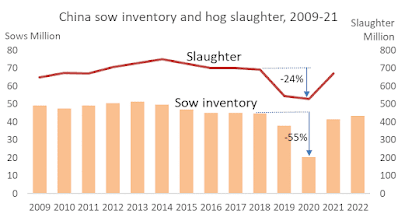
Sow inventory is level at the end of the previous year.
Data from China's National Bureau of Statistics. 

Most commentators thought it would take years for China to rebuild its swine herd to pre-ASF levels, yet the agriculture ministry declared in 2021 that production capacity had already recovered to its normal level. These numbers are miraculous.
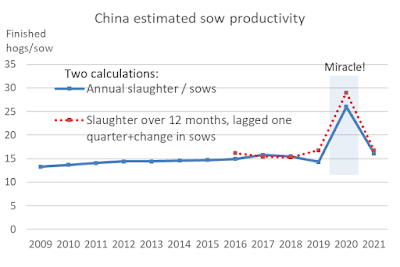
You can only produce pigs by breeding sows, waiting nearly 4 months for them to produce a litter, weaning the piglets and feeding them another 4-5 months until they reach a market weight. Sows can be bred maybe twice a year. Dim Sums calculated the productivity of Chinese sows since 2009 to prove that China's swine recovery was indeed a miracle. 

The number of slaughtered hogs per sow rose from 13.7 to 15.5 head between 2009 and 2018. These numbers seem plausible for China's level of development and indicate modest productivity growth--a 16-percent improvement over 9 years. The hogs-per-sow ratio dropped to 14.3 in 2019 after ASF hit the industry 😟. But the hogs-per-sow ratio soared to 26 head as China's 20 million sows in January 2020 produced 671 million mature hogs before the end of that year 😮. Then, in 2021 the hogs-per-sow ratio was down to 16.1--back on the trend toward gradually higher productivity that prevailed before ASF. (An agricultural official cited a 16 hogs-per-sow productivity figure last year in his assessment of annual production capacity.)
Calculated from hog slaughter and sow numbers published by China's National Bureau of Statistics.

Let's make the calculation a little more realistic by incorporating the biological lag with quarterly data. We'll lag the slaughter numbers by 3 months (assuming half the sows at the beginning of the year are near farrowing and the other half are just being bred). Let's also account for the fact that the increase in the sow inventory during the year had to be produced by the sows. This more careful productivity = (slaughtered hogs over four quarters + the increase in number of sows)/(starting number of sows in Q1).

This second productivity calculation (the red line in the chart above) also starts out at a realistic level of about 15-16 hogs per sow during 2016-2019, then shoots up to 29 pigs per sow in 2020. Then the ratio  falls to 16.9 pigs per sow--a little higher than pre-ASF.

Both measures suggest China's sows produced miraculous numbers of pigs during 2020. China achieved Denmark's level of sow productivity for a year, then returned to China's productivity level in 2021. 

The numbers are even more miraculous when we consider that it was widely reported during 2020 that Chinese farms began taking "third generation" females meant for the fattening barn and breeding them as sows to expand production at warp speed in order to maximize profit during a year of record-high prices. We heard that these females had low productivity--they had smaller litters and fewer litters than "second generation" sows. Moreover, core breeding farms were decimated by culling and disease and could not be restocked because imports of breeding stock was shut down during the ASF epidemic. But the massive one-year spike in productivity proves we were wrong about all that. Those sows popped out nearly twice as many pigs as previous generations did.

I don't know how to explain this miracle of pig productivity. It's right there in the statistics, and statistics don't lie, do they? In China's superior agricultural system pigs can be created out of thin air just when they're needed.

Comments

Anonymous said…
statistics lie in china

but price doesnt lie as much

hogs price clearly trades where it does because there are more hogs...

Popular posts from this blog

Xi Jinping's Doctoral Thesis

Xi Jinping is the vice president and presumed next president of China but little is known about him. In this post the dimsums blog offers its contribution to the genre of Xi Jinping-ology by conveying Xi's decade-old views on agricultural markets. Ten years ago Xi Jinping wrote a thesis, "Tentative Study of Agricultural Marketization" (中国农村市场化研究) for a Doctor of Law degree at Tsinghua University in Beijing, a top breeding-ground for Chinese officials. The dimsums blogger has spent several hours poring over the 200-plus page tome to see what it reveals about Dr. Xi. The thesis is remarkably close to what China has been doing lately in agricultural policy, suggesting that Xi (or the person who actually wrote the thesis) has a major say in policy or is at least in agreement with what's being done. There is nothing adventurous, controversial (or insightful) in the thesis. It seems to be the work of a wonkish technocrat who is not prone to talk out of turn or wander from...

Divergence in U.S. & Chinese egg prices

High egg prices are a hot topic in the United States. China, in contrast, has a glut of eggs and depressed prices.  The March 14, 2025 USDA Agricultural Marketing Service weekly eggs market overview reported that U.S. egg prices continued declining during the second week of March as the supply situation improved. No significant highly pathogenic avian influenza (HPAI) outbreaks have occurred in March and U.S. egg demand is relatively light. The average U.S. wholesale price for Grade A large white eggs was $4.15 per dozen, down sharply from their February peak.  Until 2021, Chinese and U.S. wholesale egg prices had been roughly equal at about $1-to-$2 per dozen with no trend. U.S. prices fluctuated more than Chinese prices, so the U.S. price was sometimes higher, sometimes lower than the Chinese price after converting them to dollars per dozen.  Chinese prices converted using monthly exchange rate and assuming 0.6 kg per dozen. Sources: USDA and China Ministry of Agricult...

China's Corn & Wheat Imports Down 97% From Last Year

China's first customs data for 2025 feature a 97-percent decline in corn and wheat imports from a year earlier. Soybean imports were up slightly by volume (but down in value), and dairy, pork, poultry, and seafood imports rebounded year-on-year. Life was less sweet in China with a 93.7% decline in sugar imports, and drinking appears to be up as wine and beer imports posted gains.   China's agricultural imports for January-February 2025 were down 14.7 percent from a year earlier. The value of farm and food goods imported for the first two months of 2025 totaled $30.7 billion, down $5.26 billion from the same period in 2024. China's exports of agricultural products during January-February totaled $15.2 billion, up $393 million from a year earlier.  Data from China Customs Administration website. As usual, soybeans were the largest component of China's agricultural imports during January-February 2025 with a value of $6.3 billion. Meat imports were valued at $4.1 billion, ...