Deflation in China's Agricultural Prices

There's much chatter about China falling into deflation after its July 2023 CPI report showed a -0.3 percent year-on-year decline. The food and beverage component of CPI showed a -0.5 percent year-on-year decrease that reflected mainly a crash in meat prices--especially a 26 percent decrease in pork prices from a year ago. Meanwhile, China's Q2 2023 index of farm prices (most recent available) showed a tiny -0.4 percent decrease from last year.

Looking at prices of individual commodities from China's grain bureau, ag ministry, and rural market prices shows a falling trend or plateau for many commodities that began early in 2023 as the post-COVID-lockdown recovery narrative began to vaporize. Signs of deflation are surprisingly evident in Chinese ag prices, despite farmers abandoning land, floods, and downward pressure from surging imports. 

Chinese soybeans are a clear example. Xi Jinping ordered an increase in soybean production last year to reduce reliance on imported beans as a major national security initiative. Statisticians reported a record 20-million-ton harvest, but it glutted the market. Average soybean procurement prices reported by China's Administration of Grain and Commodity Reserves were strong until September 2023 when the new Chinese harvest came online. Then prices immediately began to plummet, an the slide continued throughout the marketing year except for a brief bump in March-April when purchases for reserves briefly elevated prices. The July 2023 domestic Chinese soybean procurement price was down 15 percent from a year earlier. These prices tell a more pessimistic story than China's official farm price index which showed a small 2-percent decrease in soybean prices as of Q2 2023. Meanwhile, China's soybean imports are up 15 percent so far this year, with 9.7 million tons imported in July 2023 alone.


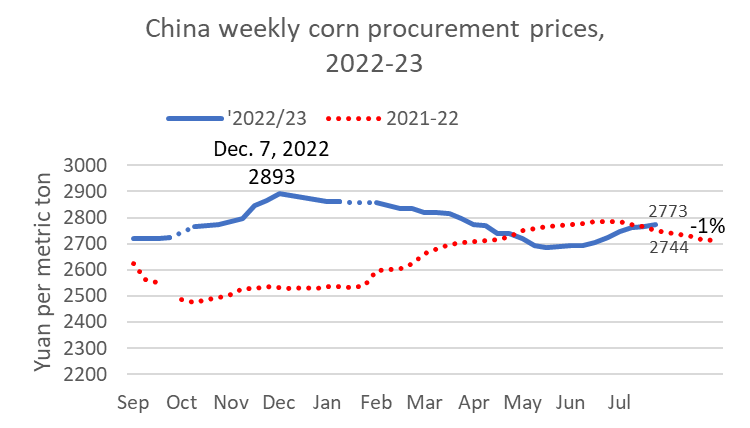
Chinese corn prices rose after the 2022 Russia invasion of Ukraine and increased some more in the first months after the 2022 harvest until reaching a peak in December 2022. Then weakness set in for Chinese corn prices in December. Chinese corn prices softened during 2023 and are now very close to their year-earlier level.  

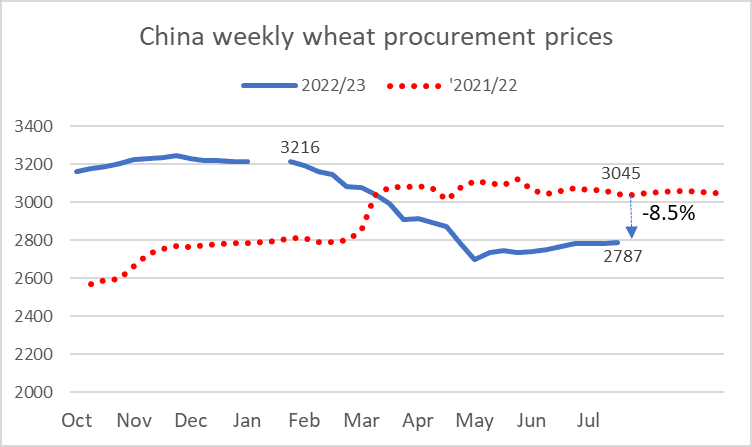
Chinese wheat prices also showed a clear bump in 2022 after the invasion of Ukraine. Like corn prices, wheat prices began dropping early in 2023. The fall in wheat prices ended abruptly in May 2023 as heavy rains damaged the new winter wheat crop in some key production areas of China. The rebound in wheat prices over the summer has been barely perceptible. July 2023 wheat prices were down 8.5 percent from year-earlier levels.

Chinese hog prices were on the way up a year ago, but they peaked in October 2022 and fell sharply late in the year as a surplus of hogs was dumped into a weaker-than-expected market. Prices deteriorated further in 2023. July hog prices were down 32 percent from a year earlier.
China's beef prices peaked in January 2023 and fell at an accelerating rate from January to July. July wholesale beef prices were down 6.7 percent from a year earlier. 
China's raw milk prices have also been in freefall during 2023. July raw milk prices were down 8.8 percent from a year earlier.
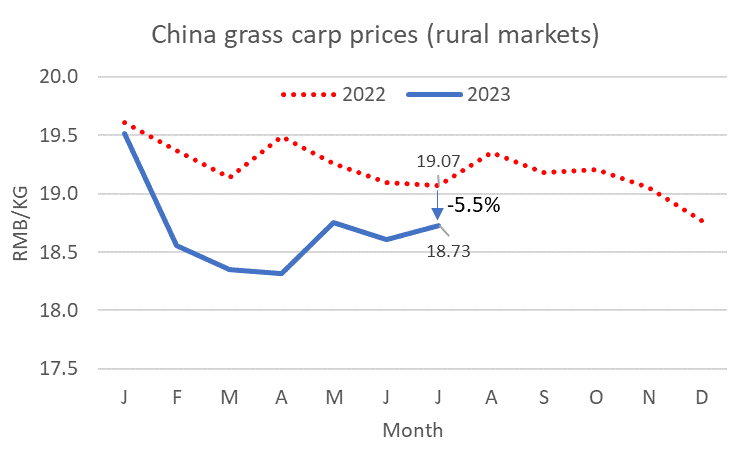
Fish also shows some weakness. Grass carp prices in rural markets fell sharply early in 2023 before rebounding slightly by July. The July 2023 grass carp price was down 5.5 percent from a year earlier. 


Rice is an exception, with prices up slightly from a year earlier. Long grain prices are mostly flat, despite all the turbulence in the global market. Medium grain prices have turned up very slightly with the most recent flooding having hit rice-producing areas in the northeast.


This is not an exhaustive analysis of agricultural prices in China, but it's enough to demonstrate that downward pressure from weak demand is evident in this sector of China's sputtering economy. 


Comments

Godfree Roberts said…
China's sputtering economy is sputtering quite nicely, despite what you've heard.
In fact, China's economy is red hot.
GDP is $30 trillion PPP
5% growth = $1.5 trillion.
$1.5 trillion = more than the GDP of 192 countries.
$1.5 trillion = more than US + EU growth combined.
$1.5 trillion = 30% of global growth.
America's 1% growth = 9% of global growth.
Alice Christian said…
Great read! Your insights on China’s agricultural price deflation are eye-opening. It’s interesting to see how these trends might impact global markets. Looking forward to more of your analysis! divorcios en nueva jersey

Popular posts from this blog

Xi Jinping's Doctoral Thesis

Xi Jinping is the vice president and presumed next president of China but little is known about him. In this post the dimsums blog offers its contribution to the genre of Xi Jinping-ology by conveying Xi's decade-old views on agricultural markets. Ten years ago Xi Jinping wrote a thesis, "Tentative Study of Agricultural Marketization" (中国农村市场化研究) for a Doctor of Law degree at Tsinghua University in Beijing, a top breeding-ground for Chinese officials. The dimsums blogger has spent several hours poring over the 200-plus page tome to see what it reveals about Dr. Xi. The thesis is remarkably close to what China has been doing lately in agricultural policy, suggesting that Xi (or the person who actually wrote the thesis) has a major say in policy or is at least in agreement with what's being done. There is nothing adventurous, controversial (or insightful) in the thesis. It seems to be the work of a wonkish technocrat who is not prone to talk out of turn or wander from...

Divergence in U.S. & Chinese egg prices

High egg prices are a hot topic in the United States. China, in contrast, has a glut of eggs and depressed prices.  The March 14, 2025 USDA Agricultural Marketing Service weekly eggs market overview reported that U.S. egg prices continued declining during the second week of March as the supply situation improved. No significant highly pathogenic avian influenza (HPAI) outbreaks have occurred in March and U.S. egg demand is relatively light. The average U.S. wholesale price for Grade A large white eggs was $4.15 per dozen, down sharply from their February peak.  Until 2021, Chinese and U.S. wholesale egg prices had been roughly equal at about $1-to-$2 per dozen with no trend. U.S. prices fluctuated more than Chinese prices, so the U.S. price was sometimes higher, sometimes lower than the Chinese price after converting them to dollars per dozen.  Chinese prices converted using monthly exchange rate and assuming 0.6 kg per dozen. Sources: USDA and China Ministry of Agricult...

China's Corn & Wheat Imports Down 97% From Last Year

China's first customs data for 2025 feature a 97-percent decline in corn and wheat imports from a year earlier. Soybean imports were up slightly by volume (but down in value), and dairy, pork, poultry, and seafood imports rebounded year-on-year. Life was less sweet in China with a 93.7% decline in sugar imports, and drinking appears to be up as wine and beer imports posted gains.   China's agricultural imports for January-February 2025 were down 14.7 percent from a year earlier. The value of farm and food goods imported for the first two months of 2025 totaled $30.7 billion, down $5.26 billion from the same period in 2024. China's exports of agricultural products during January-February totaled $15.2 billion, up $393 million from a year earlier.  Data from China Customs Administration website. As usual, soybeans were the largest component of China's agricultural imports during January-February 2025 with a value of $6.3 billion. Meat imports were valued at $4.1 billion, ...