
China & Iran Talk Ag Cooperation

China's Ag Minister met with Iranian and U.S. officials last week. The contrasting reports on the meetings perhaps reveal who China thinks its friends are. 

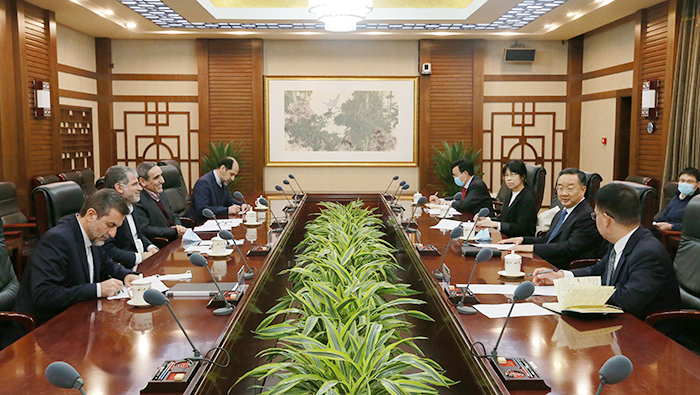
On February 15, 2023, Tang Renjian, Minister of Agriculture and Rural Affairs met with Iranian Agriculture Minister Seyyed Javad Sadati Nejad in conjunction with Iranian President Raisi's meeting with Xi Jinping. The meeting focused on Minister Tang's proposals for China-Iran cooperation in agriculture to support the "consensus" reached by Presidents Xi and Raisi, according to an article posted on the English Ministry of Agriculture site (it also appeared on the Chinese version). Minister Tang proposed holding a policy dialogue, and suggested exchanges in dryland agriculture, new plant varieties, soil health, and trade cooperation.

The Agriculture Ministry publicists thought it was very important for the world to see the Chinese agriculture minister joking around with his Iranian counterpart:

On February 17, Minister Tang met the U.S. ambassador to China Nicholas Burns to discuss ideas for China-U.S. agricultural cooperation to follow up on the Bali meeting between Presidents Xi and Biden. No actual ideas or substance were mentioned in the 1-sentence report on the Chinese Ministry of Agriculture web site. The meeting was not reported on the English version of the site. 

Here's what the publicists of China's Agriculture Ministry wanted to show you about the meeting with the U.S. Ambassador:


(Nothing)

Comments

Anonymous said…
IRIS Shahid Bagheri Excellent article with clear insights, well-researched facts, and impressive presentation overall

Popular posts from this blog

China's Vanishing Soybean Self-Sufficiency Rhetoric

Chinese propagandists appear to have given up on soybean self-sufficiency now that China has gained the upper hand over the U.S. on the soybean trade war front. The barrage of Chinese articles about finding soymeal substitutes, low protein animal diets, corn-soy intercropping, etc. has quietly faded from Chinese media. China's plan to bolster soybean self-sufficiency actually failed, but Brazil's bottomless soybean supplies nevertheless enabled China to snub U.S. soybean producers during last year's trade war. Xi Jinping now is free to make offers of soybean purchases to President Trump in trade negotiations without appearing to do so from a weak position. Mission accomplished, but not in the way Chinese strategists planned. Back in 2019--at the height of the first U.S.-China trade war--China's "Number 1 Document" announced a "soybean revitalization plan" to increase self-sufficiency in soybeans. Soybeans were pronounced to have strategic significanc...

Xi Jinping's Doctoral Thesis

Xi Jinping is the vice president and presumed next president of China but little is known about him. In this post the dimsums blog offers its contribution to the genre of Xi Jinping-ology by conveying Xi's decade-old views on agricultural markets. Ten years ago Xi Jinping wrote a thesis, "Tentative Study of Agricultural Marketization" (中国农村市场化研究) for a Doctor of Law degree at Tsinghua University in Beijing, a top breeding-ground for Chinese officials. The dimsums blogger has spent several hours poring over the 200-plus page tome to see what it reveals about Dr. Xi. The thesis is remarkably close to what China has been doing lately in agricultural policy, suggesting that Xi (or the person who actually wrote the thesis) has a major say in policy or is at least in agreement with what's being done. There is nothing adventurous, controversial (or insightful) in the thesis. It seems to be the work of a wonkish technocrat who is not prone to talk out of turn or wander from...

Divergence in U.S. & Chinese egg prices

High egg prices are a hot topic in the United States. China, in contrast, has a glut of eggs and depressed prices.  The March 14, 2025 USDA Agricultural Marketing Service weekly eggs market overview reported that U.S. egg prices continued declining during the second week of March as the supply situation improved. No significant highly pathogenic avian influenza (HPAI) outbreaks have occurred in March and U.S. egg demand is relatively light. The average U.S. wholesale price for Grade A large white eggs was $4.15 per dozen, down sharply from their February peak.  Until 2021, Chinese and U.S. wholesale egg prices had been roughly equal at about $1-to-$2 per dozen with no trend. U.S. prices fluctuated more than Chinese prices, so the U.S. price was sometimes higher, sometimes lower than the Chinese price after converting them to dollars per dozen.  Chinese prices converted using monthly exchange rate and assuming 0.6 kg per dozen. Sources: USDA and China Ministry of Agricult...