A new registration system for milk powder products in China is aimed at paring down the bewildering number of formulas and brands that crowd retail shelves, news media say.

New regulations announced last October require milk powder producers to register with China's Food and Drug Administration before the regulations come into force January 1, 2018. Companies will be permitted to register no more than 9 milk powder products: up to 3 milk formula lines, each with up to 3 formula products. Companies with R&D, inspection capacity, and their own production equipment are permitted to register.
CFDA recently announced approval of 89 milk formula products submitted by the first set of 22 companies to register. Two more rounds of registration are expected before the January 1 deadline.
China Economic Times says the regulation is aimed at reducing the excessive number of brands and products. Statistics show there were 103 infant formula producers offering 2000 different formulas in the Chinese market. Some companies paste labels on cans of milk powder produced by others.
The so-called "strictest new policy" does not allow companies to market products through agents, prohibits sticking labels on products, limits raw material to cow and goat milk, requires companies to use their own production processing facilities and demands that fresh milk used in powder must come from the company's own "production base."
A Peoples Daily article earlier this year, "Are Domestic Dairy Companies Ready?" suggested that the regulation is aimed at consolidating and strengthening the domestic infant formula industry as the two-child policy allows more births which creates greater demand for the product. According to the article, domestic companies are not benefiting as expected from vigorous demand.
By weeding out weak and untrustworthy suppliers, the regulation is expected to raise the profile of remaining domestic suppliers. Peoples Daily suggests that the regulation is intended to weed out companies whose business focuses solely on marketing, leaving companies that produce quality products. According to Peoples Daily, 200-300 small and medium companies already quit the industry in 2016, largely because of the new registration requirements. They expect more exits.
The new regulations are to be applied equally to foreign and domestic suppliers. According to Southern Metropolitan News, some observers were surprised that foreign brands accounted for only 20 percent of the initial set of approved formula products. Some industry insiders think the regulations are tilted toward strengthening the position of domestic companies in an industry where foreign brands are most popular. An industry association official says that foreign companies have taken longer to register because they have less knowledge about the process and it takes them longer to assemble and notarize paperwork. Others say many companies are holding back and watching to see how the leading companies cope with the new requirements.
Southern Metropolitan News suggests that some companies were eager to be in the first batch of approved companies to gain approval from consumers. Others say the first set of companies are not necessarily the best ones and they expect any advantage from being among the first to register will fade quickly.

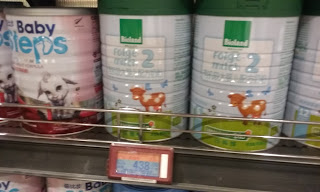
Milk powder products in a Chinese supermarket.
New regulations announced last October require milk powder producers to register with China's Food and Drug Administration before the regulations come into force January 1, 2018. Companies will be permitted to register no more than 9 milk powder products: up to 3 milk formula lines, each with up to 3 formula products. Companies with R&D, inspection capacity, and their own production equipment are permitted to register.
CFDA recently announced approval of 89 milk formula products submitted by the first set of 22 companies to register. Two more rounds of registration are expected before the January 1 deadline.
China Economic Times says the regulation is aimed at reducing the excessive number of brands and products. Statistics show there were 103 infant formula producers offering 2000 different formulas in the Chinese market. Some companies paste labels on cans of milk powder produced by others.
The so-called "strictest new policy" does not allow companies to market products through agents, prohibits sticking labels on products, limits raw material to cow and goat milk, requires companies to use their own production processing facilities and demands that fresh milk used in powder must come from the company's own "production base."

A Peoples Daily article earlier this year, "Are Domestic Dairy Companies Ready?" suggested that the regulation is aimed at consolidating and strengthening the domestic infant formula industry as the two-child policy allows more births which creates greater demand for the product. According to the article, domestic companies are not benefiting as expected from vigorous demand.
By weeding out weak and untrustworthy suppliers, the regulation is expected to raise the profile of remaining domestic suppliers. Peoples Daily suggests that the regulation is intended to weed out companies whose business focuses solely on marketing, leaving companies that produce quality products. According to Peoples Daily, 200-300 small and medium companies already quit the industry in 2016, largely because of the new registration requirements. They expect more exits.
The new regulations are to be applied equally to foreign and domestic suppliers. According to Southern Metropolitan News, some observers were surprised that foreign brands accounted for only 20 percent of the initial set of approved formula products. Some industry insiders think the regulations are tilted toward strengthening the position of domestic companies in an industry where foreign brands are most popular. An industry association official says that foreign companies have taken longer to register because they have less knowledge about the process and it takes them longer to assemble and notarize paperwork. Others say many companies are holding back and watching to see how the leading companies cope with the new requirements.
Southern Metropolitan News suggests that some companies were eager to be in the first batch of approved companies to gain approval from consumers. Others say the first set of companies are not necessarily the best ones and they expect any advantage from being among the first to register will fade quickly.
Comments