The eighth annual survey of rural migrant workers released by China's National Bureau of Statistics last week shows that the geyser of cheap labor flowing out of the country's vast hinterland slowed to a trickle during 2015. The number of nonfarm workers from rural areas grew just 3.5 million during 2015, the slowest rate since the recession year of 2009. The growth in rural workers peaked during the stimulus-fueled growth year of 2010 when the rural migrant workforce swelled by nearly 12.5 million. Since then, growth in the rural migrant labor force has tailed off.

The NBS survey estimated that 277 million people from rural households were employed in nonfarm jobs during 2015. That represents 36 percent of total employment in China (774.5 million) last year. Of the 277 million rural employees, 168.8 million were employed outside the district where they reside and 108.6 million were employed near home. The number of rural migrants working away from their home district barely grew last year. That was a big change from the peak growth years of 2009-2012 when migrants working away from home constituted most of the growth.
The countryside is no longer the major source of new laborers. The 3.5-million growth in rural nonfarm employees was only a fraction of the 13.1-million increase in urban employment reported in NBS's economic communique for 2015.
The growth rates of rural migrant employment and wages have fallen from the peak growth years of 2009-11. Wage growth has slowed from a peak of 21 percent during 2011 to 7.2 percent during 2015. Employment growth has fallen from 5.4 percent during 2010 to 1.3 percent in 2015.

While rural Chinese workers' wages grew at about three times the rate of growth in U.S. wages, they were still low. Monthly earnings of rural workers converted to U.S. dollars reached $489 in 2015, more than double average earnings in 2009. Workers toiled an average of 8.7 hours a day, 25.2 days a month to earn their wages.
Converted to U.S. dollars, Chinese rural workers' earnings were $2.46 per hour. While they are earning twice as much as they did six years ago, wages still fall short of those in developed countries. China now has commodity and real estate prices that are among the highest in the world and it has companies that can splash out billions of dollars to buy other companies, yet wages are still a fraction of those in other countries.

Rural migrants shuttle back and forth between city jobs and their home villages. They were employed an average of 10.1 months in 2015. Their total earnings from nonfarm jobs of 31,000 yuan was nearly equal to the average urban per capita income in China in 2015. Thus, rural migrant worker wages are near parity with overall average earnings in China. (In fact, there are complaints in China that many university graduates earn less than migrant workers.) However, rural migrant wages were nearly three times the average rural per capita income, an indication of the very low earnings from agriculture that brings down the rural average.
Rural migrant laborers haven't gotten the memo about the consumption-driven economy. They are working and saving machines who live on a shoestring. 70 percent of their earnings are either saved or sent home to support elders and cover big expenses like school fees, medical expenses, new houses, weddings, and funerals. Average monthly living expenses of rural migrants working away from home averaged 1012 yuan ($162) per month, just 30 percent of their monthly earnings of 3359 yuan ($489). Their housing expenses were just 475 yuan ($76).
We can deduce that rural migrants inject a lot of cash into China's rural economy. The 2,347-yuan surplus of their wages over expenses multiplied by 168.8 million migrant workers living away from home equals 369 billion yuan per month, or 3.7 trillion yuan annually if migrants work ten months. Most of that is sent back to villages. By comparison, GDP from "primary industry"--which is mainly agriculture--totaled 6 trillion yuan.
The move to a services-based economy is not favorable to rural migrants since wages in service industries are low. Transportation and construction trades brought the highest wages for China's rural migrants. Manufacturing jobs brought wages about 16% less than transportation jobs. Services--wholesale, retail, hotel, restaurant, and household services--brought wages about 23% less than transportation jobs.
The gradual aging of the rural migrant labor force is a sign that the supply of rural workers is maxing out. In 2011, roughly equal shares of rural non-farm laborers were ages 16-30 and over age 40, but in 2015 the over-40 workers outnumbered the young workers. In 2015, a third of rural non-farm employees were aged 30 or less, 22 percent were 31-40 years old, and 44 percent were over age 40. Employers now have to lure more old-timers in order to get more workers.
With farming incomes possibly headed downward this year and migrant wages slowing, China's countryside could be in for some tough times.

Source: Calculated from China National Bureau of Statistics rural migrant surveys.
The countryside is no longer the major source of new laborers. The 3.5-million growth in rural nonfarm employees was only a fraction of the 13.1-million increase in urban employment reported in NBS's economic communique for 2015.
The growth rates of rural migrant employment and wages have fallen from the peak growth years of 2009-11. Wage growth has slowed from a peak of 21 percent during 2011 to 7.2 percent during 2015. Employment growth has fallen from 5.4 percent during 2010 to 1.3 percent in 2015.

Source: Calculated from China National Bureau of Statistics rural migrant surveys.
While rural Chinese workers' wages grew at about three times the rate of growth in U.S. wages, they were still low. Monthly earnings of rural workers converted to U.S. dollars reached $489 in 2015, more than double average earnings in 2009. Workers toiled an average of 8.7 hours a day, 25.2 days a month to earn their wages.
Converted to U.S. dollars, Chinese rural workers' earnings were $2.46 per hour. While they are earning twice as much as they did six years ago, wages still fall short of those in developed countries. China now has commodity and real estate prices that are among the highest in the world and it has companies that can splash out billions of dollars to buy other companies, yet wages are still a fraction of those in other countries.
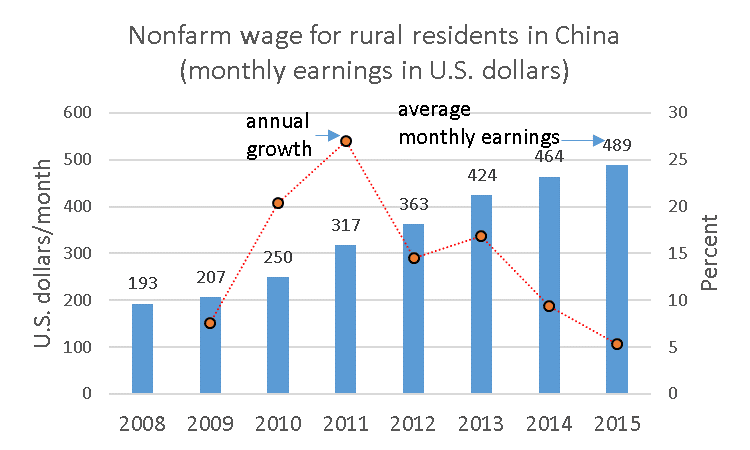
Source: Calculated from China National Bureau of Statistics rural migrant surveys.
Rural migrants shuttle back and forth between city jobs and their home villages. They were employed an average of 10.1 months in 2015. Their total earnings from nonfarm jobs of 31,000 yuan was nearly equal to the average urban per capita income in China in 2015. Thus, rural migrant worker wages are near parity with overall average earnings in China. (In fact, there are complaints in China that many university graduates earn less than migrant workers.) However, rural migrant wages were nearly three times the average rural per capita income, an indication of the very low earnings from agriculture that brings down the rural average.
Rural migrant laborers haven't gotten the memo about the consumption-driven economy. They are working and saving machines who live on a shoestring. 70 percent of their earnings are either saved or sent home to support elders and cover big expenses like school fees, medical expenses, new houses, weddings, and funerals. Average monthly living expenses of rural migrants working away from home averaged 1012 yuan ($162) per month, just 30 percent of their monthly earnings of 3359 yuan ($489). Their housing expenses were just 475 yuan ($76).
We can deduce that rural migrants inject a lot of cash into China's rural economy. The 2,347-yuan surplus of their wages over expenses multiplied by 168.8 million migrant workers living away from home equals 369 billion yuan per month, or 3.7 trillion yuan annually if migrants work ten months. Most of that is sent back to villages. By comparison, GDP from "primary industry"--which is mainly agriculture--totaled 6 trillion yuan.
The move to a services-based economy is not favorable to rural migrants since wages in service industries are low. Transportation and construction trades brought the highest wages for China's rural migrants. Manufacturing jobs brought wages about 16% less than transportation jobs. Services--wholesale, retail, hotel, restaurant, and household services--brought wages about 23% less than transportation jobs.
The gradual aging of the rural migrant labor force is a sign that the supply of rural workers is maxing out. In 2011, roughly equal shares of rural non-farm laborers were ages 16-30 and over age 40, but in 2015 the over-40 workers outnumbered the young workers. In 2015, a third of rural non-farm employees were aged 30 or less, 22 percent were 31-40 years old, and 44 percent were over age 40. Employers now have to lure more old-timers in order to get more workers.
With farming incomes possibly headed downward this year and migrant wages slowing, China's countryside could be in for some tough times.
Comments