Would you like your flour leaded or unleaded?
Would you like a tumor with that rice?
China's soil and water are heavily polluted with heavy metals that are absorbed into grain and vegetables. Chinese officials' insistence that its people eat grains grown in the country may expose them to a heightened risk of tumors and birth defects from ingesting pollutants contained in grains and vegetables.
The dimsums blog has posted reports on heavy metal contamination, "dead soil," "cadmium rice," the secret soil survey, and the Ministry of Agriculture's admission that agricultural pollution is "relatively serious." Today dimsums summarizes "Crisis and Response in the Food Chain," a well-documented article posted on a web site of the Development Research Center, a think tank that advises China's State Council on economic and social issues.
The article cites a "harsh reality" of contemporary China: a high incidence of cancer reported by China's 2012 "tumor registry," 259 "cancer villages", and a high rate of birth defects. The lifetime probability of contracting cancer is said to be 22 percent. China produces 900,000 children with birth defects annually and is classified by the World Health Organization as a country with a high rate birth defects. The author notes that the human body is an open system that is exposed to its surrounding environment. The article warns that an "alarm bell" has been sounded on food as a potential source of health problems.
Would you like a tumor with that rice?
China's soil and water are heavily polluted with heavy metals that are absorbed into grain and vegetables. Chinese officials' insistence that its people eat grains grown in the country may expose them to a heightened risk of tumors and birth defects from ingesting pollutants contained in grains and vegetables.
The dimsums blog has posted reports on heavy metal contamination, "dead soil," "cadmium rice," the secret soil survey, and the Ministry of Agriculture's admission that agricultural pollution is "relatively serious." Today dimsums summarizes "Crisis and Response in the Food Chain," a well-documented article posted on a web site of the Development Research Center, a think tank that advises China's State Council on economic and social issues.
The article cites a "harsh reality" of contemporary China: a high incidence of cancer reported by China's 2012 "tumor registry," 259 "cancer villages", and a high rate of birth defects. The lifetime probability of contracting cancer is said to be 22 percent. China produces 900,000 children with birth defects annually and is classified by the World Health Organization as a country with a high rate birth defects. The author notes that the human body is an open system that is exposed to its surrounding environment. The article warns that an "alarm bell" has been sounded on food as a potential source of health problems.
The author says he was alarmed when he first tested vegetables from Hunan Province in 2008 and found arsenic and lead content at double the allowed tolerance, cadmium 68.8% over the limit, and nickel 10% over the tolerance. He worried that Hunan, known as "the land of fish and rice," had become a scourge of the Chinese people.
The broad patterns are "cadmium in the south, lead in the north." Rice in south China is widely contaminated with cadmium and wheat in northern provinces is contaminated with lead. Metals can be absorbed from the air through leaves or from soil and water through the roots. It can accumulate in the stems, leaves, and grain kernels and then be ingested by humans.
In northern China, lead contamination is concentrated in certain areas, but testing indicates that it is spreading more widely. The contamination problems are most serious in areas near mines and manufacturers where tailings and emissions leach into the soil, wash into the water and pollute the air. Shanxi Province is perhaps the most heavily polluted. Mining areas in northern Jiangsu and industrialized areas around Taihu Lake also show unusually high levels of soil contamination. In a mining district near Xuzhou, wheat had lead content 80 times higher than the allowed tolerance and chromium was 180 times the tolerance.
Mining, galvanizing, dyeing, and tire manufacturing are major sources of pollutants. Household waste water is often used for agricultural irrigation near cities and in dry regions where water is scarce. Testing of wheat in a 250-meter strip of land along the Shanghai-Ningbo expressway found that levels of lead were double the tolerance.
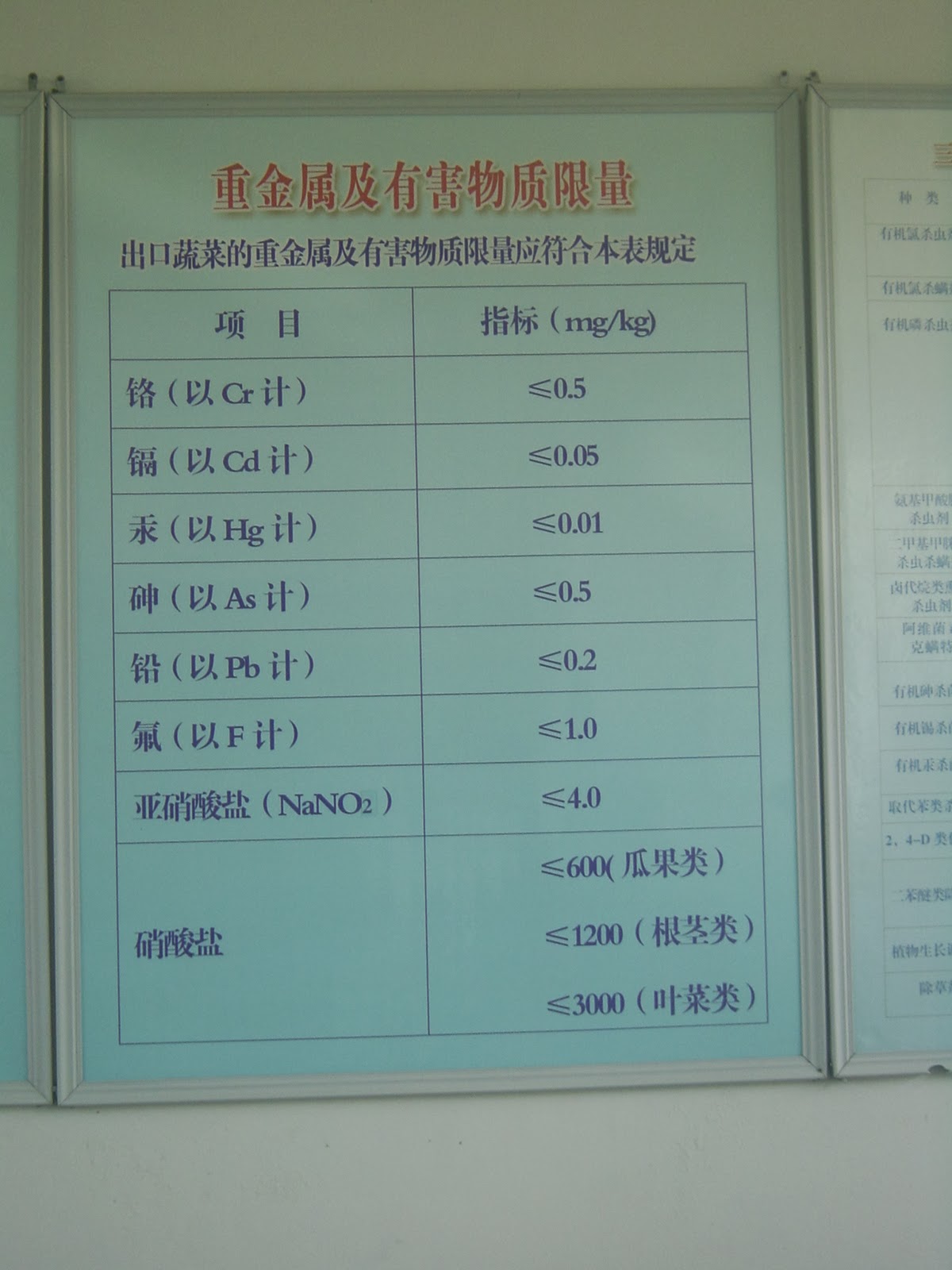
Standards for heavy metals posted on the wall at a farm growing vegetables for export.
Farms supplying the domestic market have no such signs.
The article cites several studies conducted in different parts of Henan Province between 2009 and 2012 which found wheat kernels and soil had concentrations of lead, mercury, chromium, zinc, and nickel far above allowed levels.
"Organic" fertilizer may be another source of soil and water pollution. A number of heavy metals are added to animal feed to improve digestion or the animal's appearance, but only a fraction of the metals are absorbed by the animal's digestive tract. Most of the heavy metals pass into the animal's manure which may be used as organic fertilizer for crops. (China is expanding a subsidy program to encourage use of organic fertilizer.) This organic fertilizer may also add heavy metals to the soil which are then absorbed by crops.
Monitoring by the Shijiazhuang disease control center found that lead residues exceeded tolerances in 50% of pig kidneys, 44% of pork, 35% of rice, and 30% of flour. Testing of seafood from the Bohai Gulf in northern China also showed heavy metal residues exceeded the limits.
Another pollutant is arsenic. China has an estimated 70% of the world's arsenic reserves. Mining and smelting activities in southwestern provinces blow the poison into the air. The heavy rains and steep hillsides common to this region result in mining slag being washed into river systems. Arsenic is also used as a feed additive to give pigs a healthy-looking pink complexion and shiny fur.
A 2010 academic study found high levels of arsenic in Chinese rice. In mining areas of Guangxi Province, 35% of rice had excessive arsenic levels. Arsenic has been detected in Hubei, a region where arsenic is not prevalent. It is believed arsenic from industrial emissions flowed into the groundwater. Monitoring in north China indicates that arsenic levels are rising.
Heavy metal contamination is not a new phenomenon. In 1974, authorities found that rice produced in an irrigation district near Shenyang in Liaoning Province was contaminated with cadmium. In 2002, national rice testing by the Ministry of Agriculture found excessive levels of cadmium and lead.
According to the article, Chinese peoples' intake of cadmium is three times that of people in Japan and the United States. The extreme levels of cadmium in some mining areas has produced epidemics of Itai ("ouch ouch") disease.
Authorities have known about contamination of food for a long time but have kept it secret. Soil surveys are not published. According to the article, scholars have to publish their research in journals outside the country under false names.
Chinese officials are fond of insisting that "the Chinese peoples' rice bowl must remain firmly in their own grasp." Ironically, their insistence on eating only Chinese grain for so-called "food security" may be poisoning their own people.
Comments
manchester parking discount offers
parking luton airport
long stay parking Gatwick