
Virus, War Tip China Businesses into Contractionary Phase

Much of China's economy tipped into a contractionary phase this month due to virus outbreaks and geopolitical instability, according to the country's National Bureau of Statistics. 

The Bureau's purchasing managers index (PMI) declined to 49.5 in March 2022, down from 50.2 the previous month. The nonmanufacturing business index fell to 48.4 (down 3.2 points)--indicating shrinking services industry activity. An index below 50 indicates business is contracting, while above 50 indicates expansion. 

The March PMI indicates renewed contractionary pressure similar to numbers posted last September-October. The month's sub-50 index is a reversal of weak expansionary numbers posted from November to February. March has often been a strong month for the Chinese economy. The index hit 51.9 a year ago in March 2021. The index was 52.0 in March 2020 as the economy emerged from a February 2020 deep-freeze lock-down.
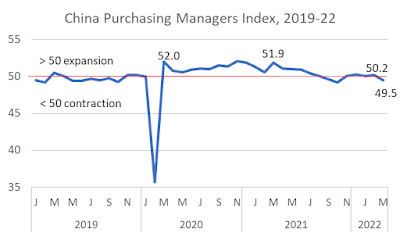
Compiled from National Bureau of Statistics reports.

One of the Bureau's senior statisticians attributed the low March 2022 PMI to clusters of virus outbreaks in many places and international geopolitical instability. The statistician said the virus had affected both supply and demand for goods, as some companies cut back or idled production. Some companies lost export orders due to recent "international geopolitical pressure." The index of new orders was 48.8. 

Industries with indexes at 45 or lower included textiles, apparel, communications equipment. On the other hand, industries with indexes still above 50 included agricultural processing, food and beverage manufacturing, electrical machinery and equipment. High-tech manufacturing is still in expansion mode, although its index was down from the previous month.

Economic pressure is a force for consolidation. Large companies have a PMI of 51.3, indicating they are still expanding. However, medium-sized companies have a PMI of 48.5 (down 2.9 points) and small companies have a PMI of just 46.6. 

The supplier delivery time index is 46.5, down 1.7 percentage points, indicating slower deliveries. The statistician explained that insufficient personnel on duty and poor logistics and transportation due to the virus is delaying transportation, affecting the stability of manufacturing supply chains. 

The March index of nonmanufacturing business activity was 48.4, down 3.2 percentage points from the previous month. Service businesses hit hardest by the virus include those in rail and air transport, hospitality, food service and other industries where interpersonal contact is common. Consumers not only fear catching the virus--patronizing a service establishment increases their risk of being snagged in a quarantine lockdown if China's surveillance system determines they were in the same location as an infected person. 

Other service industries are doing well with indexes over 60: telecommunications, broadcasting, satellite transmission services, and financial services. Construction has rebounded as warmer weather encourages resumption of building projects. 

Comments

Popular posts from this blog

Xi Jinping's Doctoral Thesis

Xi Jinping is the vice president and presumed next president of China but little is known about him. In this post the dimsums blog offers its contribution to the genre of Xi Jinping-ology by conveying Xi's decade-old views on agricultural markets. Ten years ago Xi Jinping wrote a thesis, "Tentative Study of Agricultural Marketization" (中国农村市场化研究) for a Doctor of Law degree at Tsinghua University in Beijing, a top breeding-ground for Chinese officials. The dimsums blogger has spent several hours poring over the 200-plus page tome to see what it reveals about Dr. Xi. The thesis is remarkably close to what China has been doing lately in agricultural policy, suggesting that Xi (or the person who actually wrote the thesis) has a major say in policy or is at least in agreement with what's being done. There is nothing adventurous, controversial (or insightful) in the thesis. It seems to be the work of a wonkish technocrat who is not prone to talk out of turn or wander from...

China's 2024 Ag Imports Shrank in Value

China's agricultural imports declined 7.9 percent during 2024 to reach $215 billion, according to data posted on the customs administration website. The 2024 value was lower than each of the 3 preceding years. Agricultural exports were up 4.1 percent to reach $103 billion. Source: Data from China Customs Administration December reports. The top two agricultural import categories by value both declined. Soybeans ($52.75 billion in 2024) fell 10.9 percent, and meat ($23.38 billion) fell 15.1 percent. Cereal grain imports ($15 billion) were down 28 percent and fish & shellfish imports ($18.5 billion) were down 6.2 percent. Edible oils imports ($10.6 billion) were down 17.8 percent. Fruit, rubber, cotton and wool and beverage imports were up for the year. The decline in value of imports partly reflected a decline in prices. Customs reported that the volume of soybean imports for calendar year 2024 reached a record 105 million metric tons, up 5.6 million metric tons from the previou...

Feed Boom & Cratering Grain Imports; China Leaves Us Guessing

In the first half of 2025 China increased its meat and egg production by a combined 1.58 million metric tons (mmt) from a year earlier, a moderate increase of 2.5%. Meanwhile, animal feed output during H1 2025 compiled from feed industry association reports increased by 14.5 mmt (+10 percent) from a year ago. China's 14.5-mmt increase feed output growth outpaced the 1.58-mmt growth in meat production by a ratio of 9:1. It's hard to make sense of these inconsistent figures.  [note: The June 2025 feed industry association report has a 7.7% yoy growth rate for feed output which is inconsistent with the 10.1% growth shown here calculated by comparing data from monthly reports issued last year. Growth rates for complete feed were 8.1%, concentrates -1.5%; additives 6.9%. These inconsistencies are common in the feed industry association reports, a reason for doubting the accuracy of this data.] There is no boom in demand for feed ingredients to fuel a huge increase in feed production...